Long before it became a major commercial corridor, the land surrounding Lancaster Avenue was part of the homeland of the Lenape people. Over the centuries, Indigenous trade routes, colonial roads, turnpikes, railroads, trolleys, automobiles, and eventually modern transportation systems transformed the area. Each era brought new people, new industries, and new opportunities, while also creating challenges and changing the character of the surrounding neighborhoods.
Today, Lancaster Avenue continues to evolve. Its history reflects the broader story of Philadelphia: innovation, entrepreneurship, immigration, racial justice, displacement, resilience, and community revitalization.
Before Lancaster Avenue: The Lenape Homeland
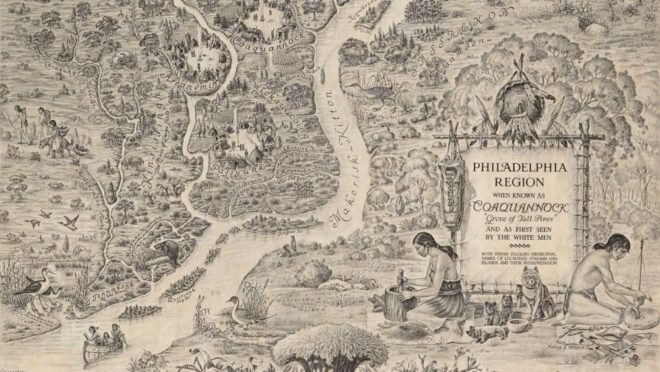
The Works Progress Administration published the little-known Coaquannock map in 1934.
Image courtesy of the Historical Society of Pennsylvania
Long before Lancaster Avenue existed, the land surrounding its route was part of Lenapehoking, the ancestral homeland of the Lenape people. The Lenape traveled through the region using an established network of trails connecting settlements, waterways, hunting grounds, and trading locations. These paths often followed natural features in the landscape, including ridgelines and relatively dry passages through wooded areas.
The Lenape maintained relationships with neighboring Indigenous nations, including the Susquehannocks and the Haudenosaunee Confederacy. These relationships involved trade, diplomacy, territorial competition, and periods of conflict. European settlement and competing colonial alliances would increasingly disrupt these relationships. Although the exact Indigenous path beneath every section of today’s Lancaster Avenue is not fully documented, the road’s origins are connected to the older trail network that crossed southeastern Pennsylvania.
William Penn, the Quakers, and a Changing Political Landscape
In 1681, William Penn received the charter for Pennsylvania from King Charles II. Penn envisioned a colony grounded in religious tolerance, representative government, and peaceful relations with Indigenous peoples. As a Quaker, Penn belonged to a religious community that emphasized peace, equality, personal conscience, and opposition to religious persecution. His approach to colonization initially included efforts to establish diplomatic and commercial relationships with the Lenape. However, the arrival of European settlers brought enormous changes. Land purchases, expanding settlements, competing colonial interests, and shifting alliances increasingly disrupted Indigenous communities. Treaties and land agreements did not always reflect the understanding or consent of the Indigenous people involved. Over time, colonial expansion reduced Lenape access to ancestral lands and contributed to their displacement. The political landscape was also changing among Indigenous nations. European powers increasingly sought alliances with Native nations, while the fur trade and territorial competition influenced relationships throughout the region. West Philadelphia’s transformation was therefore not simply the result of new roads and settlements. It was part of a much larger history of diplomacy, colonization, economic competition, and the loss of Indigenous land.
In 1697, William Penn authorized a road extending west from Philadelphia into the Pennsylvania countryside. The early road was little more than an improved passage following earlier trails. It connected Philadelphia with agricultural settlements and helped establish a route for people and goods traveling between the growing city and the interior of Pennsylvania.
As settlement expanded westward, the road became increasingly important. Farmers transported crops, merchants moved supplies, and travelers used the route to reach communities farther inland. Wagons carrying agricultural products and other merchandise became a regular sight. The road eventually became known as the Philadelphia-Lancaster Road and later the Lancaster Pike. Its importance was not limited to commerce; it also became a major route for people migrating westward through Pennsylvania.
1795: Lancaster Pike Becomes America’s First Turnpike
One of the most important events in Lancaster Avenue’s history occurred in 1795, when the Philadelphia-Lancaster Road became the first successful turnpike in the United States. The road was improved through private investment, with tolls helping pay for its construction and maintenance. Improvements included crushed-stone paving, widening, straightening, and better drainage. These changes made travel more reliable and allowed wagons and stagecoaches to move more efficiently.
For the portion of the road that crossed what is now West Philadelphia, this meant a new level of commercial importance. Lancaster Pike became a major gateway into Philadelphia for agricultural products, merchandise, travelers, and livestock arriving from the western countryside. Inns, taverns, and other services developed along the route. The improved road also encouraged settlement and commercial development in areas that would eventually become Powelton, Mantua, Hestonville, and other West Philadelphia neighborhoods.
The diagonal path of Lancaster Avenue, which remains visible today, reflects its origins as a regional road rather than a street laid out within Philadelphia’s traditional grid.
The Underground Railroad: Freedom Routes Through West Philadelphia
During the late eighteenth and nineteenth centuries, Philadelphia became a major center of Underground Railroad activity. Its proximity to slave-holding Maryland and Delaware, along with its large free Black population and Quaker abolitionist communities, made the region an important destination for people escaping slavery. Lancaster Avenue, then known as Lancaster Pike, connected Philadelphia to communities farther west and formed part of the wider network of roads used throughout southeastern Pennsylvania.
The Underground Railroad relied on free African Americans, Quakers, churches, and abolitionists who provided shelter and assistance to freedom seekers. Philadelphia abolitionist William Still helped organize this network and documented the experiences of those escaping slavery in his 1872 book, The Underground Railroad. Homes, Black churches, and Quaker meetinghouses served as safe locations, including the well-documented Johnson House in Germantown.
Lancaster Pike was an important east-west route connecting Philadelphia with communities throughout southeastern Pennsylvania, where Underground Railroad activity was documented. Although specific Underground Railroad stations along Lancaster Avenue have not yet been conclusively identified, the avenue was part of the broader transportation landscape through which freedom seekers traveled. Historic property records, maps, and church archives may help establish further connections between individual properties along the corridor and the abolitionist movement.
The Railroad Era: The 1830s–1850s
Railroads transformed the economic geography of Philadelphia and the surrounding region. The Philadelphia and Columbia Railroad began operating in the 1830s, providing an important connection between Philadelphia and the interior of Pennsylvania. Its route ran parallel to much of the Lancaster Pike. In 1850, the Pennsylvania Railroad acquired the Philadelphia and Columbia Railroad, strengthening the railroad network connecting Philadelphia to the rest of the state. Rail transportation dramatically reduced travel times and increased the volume of goods that could move between communities. At the same time, local transportation was changing. Horse-drawn omnibuses and horse-car railways began connecting West Philadelphia neighborhoods with central Philadelphia. In 1858, the Hestonville, Mantua, and Fairmount Horse Car Passenger Railway helped establish regular horse-drawn streetcar service along the Lancaster Pike. This made it easier for residents to commute, shop, and travel between neighborhoods. Commercial buildings, homes, shops, and businesses increasingly lined Lancaster Avenue. What had once been primarily a transportation route was becoming a neighborhood business district.
The Civil War Era: Philadelphia’s Industrial Powerhouse
By the time of the Civil War, Philadelphia had become one of the nation’s most important industrial centers. Its factories, machine shops, foundries, textile mills, shipyards, and transportation companies supplied essential materials to the Union war effort. Water power had played an important role in Philadelphia’s early industrial growth. Mills and manufacturing operations developed around rivers and streams, taking advantage of flowing water to power machinery. Philadelphia’s industrial base also supported innovation in engineering, manufacturing, and transportation. The city’s manufacturing capacity made it a critical Northern industrial powerhouse during the Civil War. The war also brought enormous social changes. Philadelphia’s free Black population continued to grow, and the city became an increasingly important destination for African Americans seeking employment, safety, and greater opportunity.
After the Civil War: Steam Power and Industrial Expansion
Following the Civil War, American industry underwent another major transformation. Steam-powered factories increasingly replaced water-powered mills. Rather than depending on rivers and streams, manufacturers could establish operations in locations with access to transportation, workers, and fuel. Coal from western Pennsylvania became a critical energy source for this new industrial economy. Railroads made it possible to transport coal and other raw materials across long distances, allowing Philadelphia’s industrial sector to expand. The 1876 Centennial International Exhibition, held in Fairmount Park, celebrated America’s one-hundredth anniversary and showcased the country’s technological, industrial, and commercial achievements. Philadelphia presented itself as a city of invention and progress. These changes helped establish the economic foundation for the commercial and industrial development that would continue along Lancaster Avenue.
The Early Twentieth Century: The Lincoln Highway and the Automobile Revolution
In 1913, Lancaster Pike became part of the Lincoln Highway, the first transcontinental automobile road in the United States. The Lincoln Highway connected New York City to San Francisco, creating a coast-to-coast route that helped popularize automobile travel. For Lancaster Avenue, this was a major development. The avenue was now part of a nationally significant transportation corridor. Automobiles, delivery vehicles, trucks, and travelers moved through West Philadelphia on their way to destinations throughout the region and beyond. The automobile transformed the kinds of businesses that could succeed along the avenue. Gas stations, repair garages, tire shops, dealerships, and other automobile-related businesses became increasingly common. Lancaster Avenue developed characteristics of an automotive commercial district, with businesses serving both neighborhood residents and travelers passing through the city. Many buildings were adapted to accommodate the needs of automobile-related businesses. Ground-floor commercial spaces, wide storefronts, garages, and vehicle access became important features. Some older buildings were modified or replaced as the automobile economy expanded. The avenue’s commercial character continued to evolve, with businesses responding to changing transportation technology and consumer demand.
The Black Bottom
The Black Bottom was a predominantly African American working-class neighborhood located immediately south of Lancaster Avenue, generally extending between 32nd and 40th Streets. Its roots date back to the nineteenth century, when the area attracted European immigrants and African Americans establishing homes and businesses in West Philadelphia. As the city expanded, the neighborhood developed into a close-knit residential community with convenient access to Lancaster Avenue’s shops, transportation, and services.
Between 1910 and 1930, Philadelphia’s Black population tripled as African American families moved north from the South seeking greater opportunities and freedom from segregation, as part of the Great Migration. Many settled in the Black Bottom, establishing homes, businesses, churches, and community organizations. Lancaster Avenue served as the neighborhood’s primary commercial connection, with local businesses providing employment, goods, and services to generations of residents.
The Lincoln Highway Gives Way to the Expressway Era
By the middle of the twentieth century, transportation planning was changing once again. As automobile ownership increased, cities and governments invested in larger highways designed to move traffic quickly around and through urban areas. The Schuylkill Expressway, developed in stages during the 1950s and 1960s, changed how motorists traveled through Philadelphia. High-speed highways and suburban development encouraged travelers to bypass older commercial corridors. For Lancaster Avenue, this meant losing some of the traffic that had supported businesses during the Lincoln Highway era. At the same time, the rise of automobiles and buses contributed to the decline of the traditional streetcar system. Philadelphia’s trolley network had once been central to neighborhood transportation. However, changing transportation preferences, public policy, road construction, and the financial pressures facing transit companies contributed to the disappearance of many streetcar routes. Lancaster Avenue’s commercial fortunes became increasingly tied to the economic health of the surrounding neighborhoods rather than its role as a major long-distance travel route.
The Civil Rights Movement: Dr. Martin Luther King Jr. on Lancaster Avenue
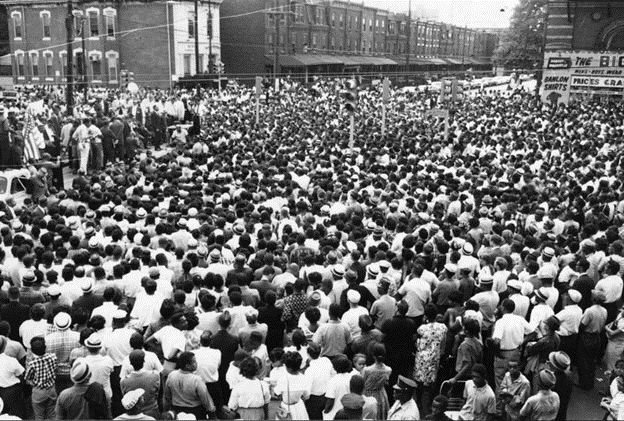
Dr. Martin Luther King, Jr. addresses over 10,000 attendees at the “Freedom Now Rally” at 40th St. and Lancaster Ave., West Philadelphia. King also held “Freedom Now” rallies in Chicago, Cleveland, and Boston.
Photo by Hamilton, Philadelphia Evening Bulletin, George D. McDowell Collection, Special Collections Research Center, Temple University Libraries (TUL), Philadelphia, PA, courtesy of TUL.
Lancaster Avenue also holds an important place in Philadelphia’s Civil Rights history. On August 3, 1965, Dr. Martin Luther King Jr. visited West Philadelphia as part of his Freedom Now campaign. Nearly 10,000 people gathered near 40th Street and Lancaster Avenue to hear him speak about racial justice, voting rights, and the ongoing struggle for equality. The rally connected Philadelphia’s local civil rights organizing with the broader national movement. It took place less than two years after the historic March on Washington and just days before President Lyndon B. Johnson signed the Voting Rights Act of 1965. Dr. King’s visit demonstrated the importance of West Philadelphia as a center of Black community life, political activism, and civic engagement. The site remains an important historical landmark. Its legacy is commemorated through historical markers and public art, including the MLK Freedom Now mural. Lancaster Avenue was not simply a place where people conducted business. It was also a gathering place where communities organized, advocated for their rights, and demanded change.
Urban Renewal, University Expansion, and the Displacement of Black Bottom
The postwar decades brought major changes to West Philadelphia. During the 1950s, 1960s, and 1970s, Philadelphia pursued redevelopment projects intended to modernize the city and attract new investment. The University of Pennsylvania, Drexel University, and other institutions expanded their presence in West Philadelphia. The growth of these institutions transformed the surrounding landscape, bringing new buildings, research facilities, housing, and commercial development. However, this expansion came at a tremendous cost to existing communities. The Black Bottom neighborhood was targeted for urban renewal and redevelopment. Homes and businesses were acquired and demolished, displacing thousands of predominantly Black residents. The creation of the University City Science Center and other institutional developments permanently changed the neighborhood. For residents, this was not simply redevelopment. It meant the loss of homes, businesses, churches, social networks, and a community built over generations. The displacement of Black Bottom remains one of the most consequential chapters in West Philadelphia’s history. Drexel University and the University of Pennsylvania became increasingly prominent institutions in the area, while the neighborhood’s original residents were forced to establish new lives elsewhere. The economic benefits of institutional expansion were not always shared equally with surrounding communities. The history of Black Bottom reminds us that development must consider the people who already live and work in a neighborhood. Progress cannot be measured by new buildings alone.
Although much of the Black Bottom was demolished, evidence of the neighborhood survives beneath the modern landscape. The Heritage West: West Philadelphia Community Archaeology Project has worked with residents, historians, and University of Pennsylvania archaeologists to uncover its history. Excavations near the 3500 block of Lancaster Avenue, behind the Community Education Center, have uncovered former residential foundations and everyday household objects. These discoveries help researchers understand how residents lived and preserve stories that are often missing from traditional historical records.
Former residents and their descendants continue to preserve the Black Bottom’s history through reunions, oral histories, and community organizations such as the Black Bottom Tribe Association. Archaeological research is also helping restore the neighborhood’s place in Philadelphia’s historical record. For Lancaster Avenue, remembering the Black Bottom is essential because its residents, workers, and entrepreneurs helped shape the avenue’s commercial and cultural identity. Its history reminds us that the success of a neighborhood depends on the people and communities who give it life.
The 1970s–1990s: Community Resilience and Changing Commercial Conditions
Following decades of urban renewal, demographic changes, and economic restructuring, many West Philadelphia neighborhoods faced challenges related to disinvestment and changing commercial patterns. Lancaster Avenue experienced periods of declining business activity, changing storefronts, and shifting neighborhood needs. However, the avenue never lost its importance as a community commercial corridor. Local business owners, residents, religious institutions, and community organizations continued working to support neighborhood life. Small businesses remained an important source of employment, services, and local identity. The surrounding universities continued to grow, bringing students, employees, visitors, and new development into West Philadelphia. Yet the relationship between institutional growth and neighborhood prosperity remained complicated. The challenge was, and continues to be, ensuring that investment and revitalization create meaningful opportunities for the people and businesses that make the neighborhood what it is.
2000s: A New Chapter for Lancaster Avenue
The early twenty-first century brought renewed attention to the importance of neighborhood-based economic development. Local businesses and community organizations increasingly recognized that Lancaster Avenue’s future depended on supporting existing entrepreneurs while attracting new investment. The 2008 financial crisis and housing market collapse created additional challenges for small businesses, property owners, and neighborhood residents. Access to capital became more difficult, development slowed, and many communities experienced economic uncertainty. In response to these challenges, local business and community leaders continued to organize around a shared vision for Lancaster Avenue.
In 2008, the Lancaster Avenue 21st Century Business Association (LA21) was founded to support the economic vitality of the Lancaster Avenue corridor. LA21’s mission centers on strengthening local businesses, encouraging investment, improving the commercial environment, and creating a more vibrant and welcoming corridor. The organization recognizes that successful revitalization requires more than attracting new businesses. It requires building relationships, supporting entrepreneurs, maintaining public spaces, and creating opportunities for residents to participate in the neighborhood’s economic future. Through partnerships with businesses, property owners, residents, institutions, and public agencies, LA21 has worked to strengthen the corridor and support its continued development.
The 2020s: Revitalization, Clean Streets, and a Stronger Business Community
Today, Lancaster Avenue is entering another important chapter. Efforts to improve the corridor include streetscape maintenance, cleaning initiatives, business support, community partnerships, and efforts to attract new commercial activity. Clean and welcoming public spaces help create an environment where businesses can thrive and residents feel connected to their neighborhood. LA21 continues to work with local stakeholders to address the everyday needs of the corridor while pursuing longer-term economic development goals. These efforts build on a much longer history of people working to make Lancaster Avenue a place of opportunity.
The Story Continues
Lancaster Avenue has never stood still. It has been a trail, a trade route, a turnpike, a railroad corridor, an automobile highway, a neighborhood main street, and a center of community activism. Its history reflects the contributions of Indigenous people, immigrants, African American families, entrepreneurs, workers, abolitionists, civil rights leaders, and generations of local business owners. Understanding this history helps us understand why Lancaster Avenue matters today. Revitalizing the corridor is not just about improving buildings or attracting new businesses. It is about recognizing the people and communities who shaped it, preserving the stories that might otherwise be forgotten, and creating opportunities for future generations.
Lancaster Avenue’s history is still being written. And its next chapter belongs to the community.
Presented by the Lancaster Avenue 21st Century Business Association (LA21).